-
by Scoosh Consultancy
- November 6, 2026
Noida FAR Policy 2026: What It Means for the Noida Real Estate Market
Industry Perspective: Piyush Bansal, Managing Director, Scoosh Consultancy
The Noida real estate market is entering an important phase of regulatory change. The Noida Authority’s adoption of the Model Building Regulations, 2026, could reshape the development potential of certain group housing projects across the city.
One of the most significant aspects of this development is the removal of the maximum Floor Area Ratio (FAR) ceiling for eligible group housing plots situated along roads wider than 45 meters.
The decision, taken during the Noida Authority’s 224th board meeting on 28 October 2026, has attracted attention from property developers, investors and homebuyers.
But what does this change actually mean? Could it encourage more high-rise residential developments? Will it influence property prices? And which parts of Noida could attract greater development interest?
In this article, Scoosh Consultancy examines the Noida FAR Policy 2026, its potential implications, and the factors property buyers should consider before making real estate decisions.
Table of Contents
ToggleUnderstanding the Noida FAR Policy 2026
Before examining the market implications, it is important to understand what FAR means and how the revised regulations could influence residential development.
What Is Floor Area Ratio (FAR)?
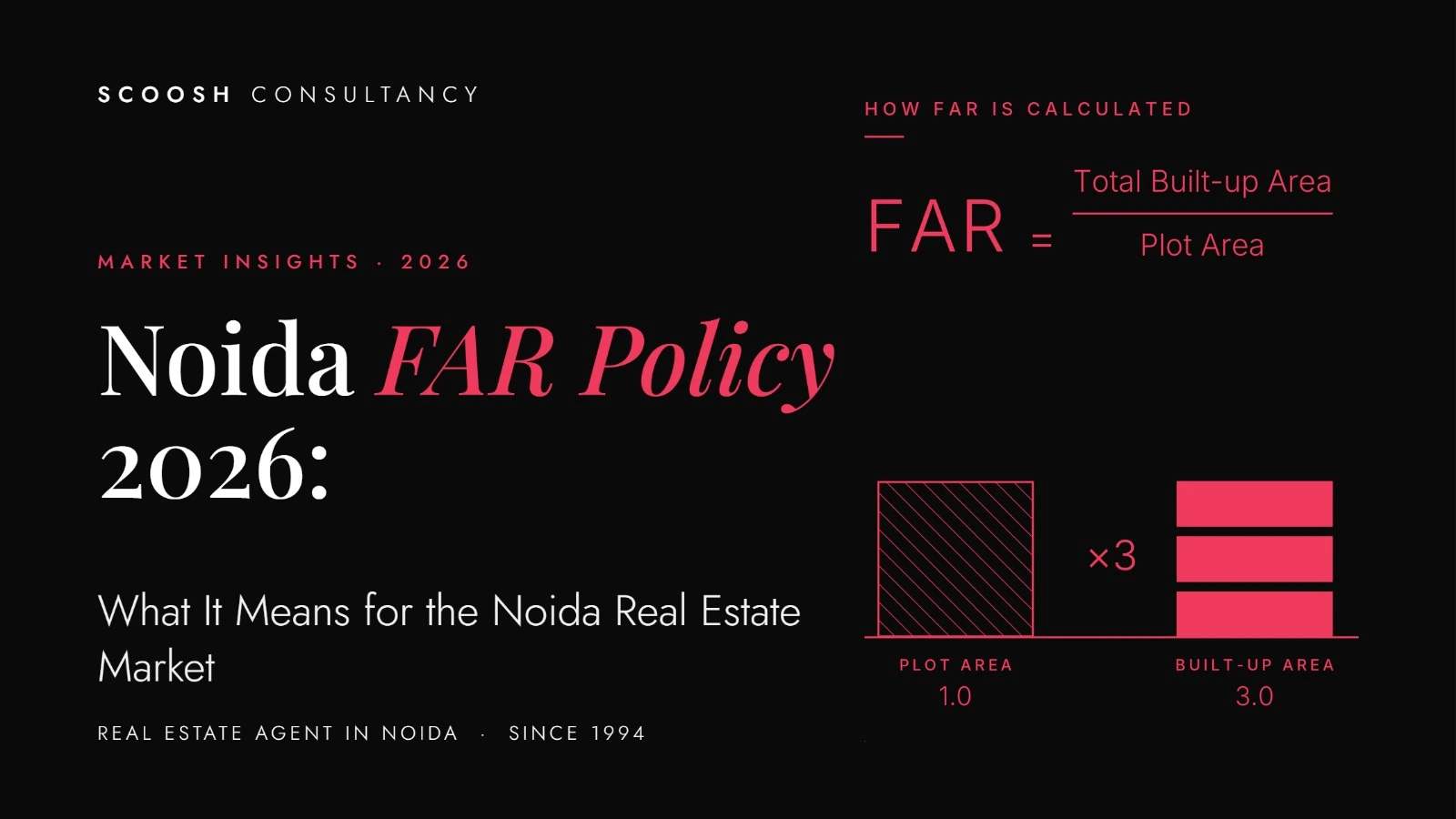
Floor Area Ratio, commonly known as FAR, determines the maximum permissible total built-up floor area in relation to the total plot area.
Development authorities use it as a key planning parameter to regulate building density and land use.
For example, consider a residential plot measuring 10,000 square meters with a permissible FAR of 3.5.
The calculation would be:
10,000 × 3.5 = 35,000 square metres
This means the permissible total floor area would be 35,000 square meters, subject to applicable building regulations.
FAR plays an important role in determining how residential and commercial developments are planned, designed and constructed.
What Has Changed Under the New FAR Rules in Noida?
Previously, the maximum permissible FAR for group housing projects in Noida was 3.5.
Under the newly adopted Model Building Regulations, 2026, the maximum FAR ceiling has been removed for eligible group housing plots abutting roads wider than 45 meters.
This creates greater development potential on qualifying land parcels.
However, removing the maximum FAR ceiling does not mean developers can construct without restrictions.
Projects must continue to comply with applicable provisions concerning:
- Building height and structural safety.
- Fire safety and emergency access.
- Ground coverage and setbacks.
- Aviation and height-related clearances.
- Parking and access requirements.
- Other applicable planning and building regulations.
The Noida Authority has also constituted a committee to examine implementation-related matters.
Consequently, the actual development potential of individual projects will depend on the applicable regulations, technical feasibility, and necessary approvals.
How Will the Noida FAR Policy 2026 Impact the Real Estate Market?
The revised FAR framework could change how Noida plans and evaluates residential developments.
Its impact, however, will depend on implementation, developer participation, infrastructure capacity, and market demand.
1. Greater Potential for High-Rise Residential Development
The new Noida FAR Policy 2026 could give developers greater flexibility in planning residential projects by removing the maximum FAR ceiling for eligible group housing plots.
Depending on applicable height, safety, and infrastructure requirements, qualifying plots may offer opportunities for higher-density residential development.
This could encourage developers to explore new project configurations and optimize available land resources.
2. Improved Land Utilization
Land acquisition and development costs are significant components of residential real estate projects. Under the Noida FAR Policy 2026, greater development potential could allow developers to utilise eligible land parcels more efficiently.
This may influence project planning, construction economics and the feasibility of future residential developments.
However, higher development potential does not automatically translate into lower construction costs or more affordable housing. Infrastructure development, financing, construction expenses and regulatory charges will continue to play an important role.
3. Potential Increase in Residential Housing Supply
If developers take advantage of the revised provisions, the policy could support additional residential inventory over time.
More housing supply may give homebuyers more choices across different residential segments.
It could also influence competition among developers and the positioning of future residential projects.
The actual impact will depend on how many eligible plots are developed and whether market demand is sufficient to support additional inventory.
4. Greater Developer Interest in Eligible Land Parcels
Under the Noida FAR Policy 2026, eligible land parcels could attract greater attention from developers exploring future residential opportunities.
Increased development potential may become an important consideration during land acquisition and project feasibility assessments.
However, developers must evaluate land valuation, location, approvals, infrastructure availability and project economics before committing to new developments.
Which Noida Locations Could Attract Greater Development Interest?
Connectivity, infrastructure and access to established residential ecosystems continue to influence real estate development across Noida.
While the new FAR provisions may encourage developers to evaluate eligible land parcels more closely, not every sector or property will automatically qualify.
Here are three key locations and corridors to watch.
Sector 150, Noida
Sector 150 has become an important residential destination in Noida.
Its residential developments, green spaces, and connectivity to the Noida-Greater Noida Expressway contribute to its appeal among homebuyers and investors.
As Noida’s development regulations evolve, the sector’s location and existing residential ecosystem make it relevant to the broader discussion around future residential development.
Noida-Greater Noida Expressway
The Noida-Greater Noida Expressway connects several residential, commercial and institutional sectors, making it an important corridor in the Noida Real Estate Market.
Its connectivity and established development ecosystem have supported real estate growth along the corridor. Under the Noida FAR Policy 2026, future development opportunities will depend on individual plot eligibility, road width, planning provisions and supporting infrastructure.
Areas Around Jewar International Airport
The development of Noida International Airport has brought increased attention to the wider Yamuna Expressway region.
Improving regional connectivity and supporting infrastructure could influence residential, commercial and industrial demand over the coming years.
However, the FAR relaxation discussed in this article should not be interpreted as automatically extending to properties in the Yamuna Expressway region. Applicable authority regulations and individual plot eligibility must be examined separately.
Important: These locations are worth monitoring because of their real estate fundamentals and connectivity. They are not confirmed beneficiaries of the revised FAR provisions.
Will the New FAR Policy Affect Property Prices in Noida?
One of the biggest questions among buyers and investors is whether the new FAR policy will make property prices in Noida more affordable or increase the value of eligible land.
The answer depends on several market factors.
Could Additional Housing Supply Moderate Price Growth?
If the revised regulations encourage more residential construction, housing inventory could increase over time.
In a market where supply grows sufficiently relative to demand, additional inventory may moderate price appreciation.
However, this outcome is not guaranteed. Housing demand, construction costs, project positioning and the pace of development will influence the eventual market impact.
Could Eligible Land Parcels Become More Valuable?
Land parcels with greater development potential may attract additional interest from developers.
This could influence land valuations, particularly where connectivity, location and infrastructure support residential development.
However, higher development potential does not automatically mean higher land prices or stronger investment returns.
Why Location and Infrastructure Will Continue to Matter
The Noida real estate market is influenced by more than regulatory changes.
Important factors include:
- Connectivity to major roads and expressways.
- Access to employment and commercial centers.
- Availability of water, electricity, and civic infrastructure.
- Developer credibility and project delivery history.
- Residential demand and surrounding development.
- Legal approvals and project compliance.
For buyers and investors, evaluating these fundamentals is more important than making decisions based solely on a policy announcement.
Infrastructure and Safety: Important Considerations for Noida’s Future Growth
Greater construction potential needs adequate urban infrastructure to support it.
As residential density increases, civic facilities and public infrastructure must develop alongside new construction.
Some important considerations include:
Road Connectivity and Traffic Management
Higher residential density can increase traffic movement.
Project planning must consider road capacity, entry and exit points, public transport connectivity, and emergency access.
Water, Electricity and Civic Infrastructure
Residential developments require reliable water supply, electricity distribution, and supporting civic facilities.
Assess infrastructure capacity before approving additional residential density.
Drainage and Sewage Management
Adequate drainage and sewage infrastructure are essential to maintain residential standards and prevent pressure on existing civic systems.
Fire and Structural Safety
High-rise developments require appropriate fire safety systems, emergency evacuation arrangements and structural compliance.
Mandatory inspections and applicable safety requirements must remain central to project approvals.
Parking and Accessibility
Developers must plan residential projects with adequate parking, pedestrian movement, accessibility, and visitor facilities.
The long-term success of the revised building regulations will depend on balancing development opportunities with safe and sustainable urban planning.
What Should Property Buyers and Investors Consider?
For anyone exploring the Noida real estate market, consider regulatory changes alongside a property’s fundamentals.
Before purchasing a residential or commercial property, evaluate the following factors:
1. Location and Connectivity
Examine the property’s proximity to expressways, metro connectivity, employment centers, schools, hospitals, and other essential facilities.
2. Legal Approvals and Documentation
Verify ownership documents, land-use permissions, building approvals, and applicable RERA registration.
For under-construction projects, examine the approved project plans and relevant regulatory disclosures.
3. Developer Reputation
Review the developer’s previous projects, construction quality, delivery history, and market credibility.
4. Infrastructure Readiness
Assess the availability of roads, water supply, electricity, drainage, sewage, and other essential services.
5. Investment Objectives
Consider your budget, intended holding period, expected rental requirements, and long-term investment goals.
6. Property-Specific FAR Eligibility
Do not assume that every residential property benefits from the revised FAR provisions.
The relaxation discussed here relates to eligible group housing plots along roads wider than 45 meters. Independent houses, builder floors and individual residential plots should not be assumed to qualify.
For developers evaluating land parcels, a detailed assessment of applicable regulations and project approvals is essential.
Piyush Bansal’s Perspective: Understanding Noida’s Changing Real Estate Landscape
Regulatory developments can create new possibilities for the real estate sector, but understanding their practical implications is equally important.
According to Piyush Bansal, Managing Director of Scoosh Consultancy, informed property decisions should consider the relationship between regulatory changes, location fundamentals, infrastructure, and long-term market demand.
As Noida continues to develop, policies such as the Model Building Regulations, 2026, highlight the importance of evaluating property opportunities through a wider market perspective.
At Scoosh Consultancy, we help clients understand property options based on their individual requirements, location preferences, and investment objectives.
Whether exploring residential properties, commercial spaces or industrial opportunities, buyers benefit from evaluating the complete picture rather than relying on market speculation.
Frequently Asked Questions About the Noida FAR Policy 2026
1. What Is the New FAR Policy in Noida for 2026?
The Noida FAR Policy 2026 adopts the Model Building Regulations, 2026, removing the maximum FAR ceiling for eligible group housing plots abutting roads wider than 45 metres, subject to applicable planning, building and safety regulations.
2. Has Noida Completely Removed the FAR Limit?
No. Under the Noida FAR Policy 2026, the maximum FAR ceiling has been removed only for the specified eligible group housing category. Other applicable building, planning, height and safety requirements continue to apply.
3. Which Properties Are Eligible for the New FAR Provisions?
The revised FAR provisions apply to eligible group housing plots located along roads wider than 45 metres. Actual eligibility under the Noida FAR Policy 2026 must be established through the applicable regulations and approval process.
4. Will the New FAR Policy Reduce Property Prices in Noida?
Not necessarily. The Noida FAR Policy 2026 could increase residential development potential and create additional housing supply, potentially moderating price growth over time. However, land valuations, construction costs, demand, connectivity and infrastructure will continue to influence property prices.
5. Does the New FAR Policy Apply to Independent Houses and Residential Plots?
The FAR relaxation under the Noida FAR Policy 2026 should not be interpreted as a general FAR increase for independent houses, builder floors or individual residential plots. The stated provision relates specifically to eligible group housing developments.
6. Will the New FAR Policy Encourage More High-Rise Buildings in Noida?
The Noida FAR Policy 2026 could create greater development potential for qualifying group housing projects. However, actual high-rise construction will depend on applicable height restrictions, fire and safety requirements, infrastructure capacity and project approvals.
7. Should Property Investors Buy Land Because of the New FAR Policy?
Investors should not make purchasing decisions based solely on the Noida FAR Policy 2026 announcement. Before investing, independently evaluate land title, plot eligibility, development approvals, location, infrastructure and overall financial feasibility.
The Road Ahead for the Noida Real Estate Market
The adoption of the Model Building Regulations, 2026, marks an important development in Noida’s urban planning framework. The Noida FAR Policy 2026 could reshape residential development by opening new possibilities for eligible group housing plots, particularly in terms of land utilisation, built-up area and high-rise construction.
Removing the maximum FAR ceiling for eligible group housing plots could create fresh opportunities for developers and influence the future supply of residential properties in Noida.
However, the long-term impact will depend on regulatory implementation, infrastructure readiness, developer participation and actual housing demand.
For property buyers and investors, understanding the Noida FAR Policy 2026 is essential. The key is to identify which projects qualify, understand the revised development potential and evaluate every property on its individual merits.
With a legacy dating back to 1994, Scoosh Consultancy continues to help clients explore residential, commercial and industrial property opportunities across Noida, Greater Noida and the Yamuna Expressway region.
Looking to explore property opportunities in Noida?
Connect with Scoosh Consultancy for informed property guidance, real estate market insights and assistance in identifying opportunities aligned with your requirements.
Website: https://scooshconsultancy.com/us
About the Author
Piyush Bansal | Managing Director, Scoosh Consultancy
Piyush Bansal leads Scoosh Consultancy, an established real estate consultancy operating since 1994.
The company assists clients with residential, commercial, industrial, and investment property requirements across Noida, Greater Noida, and the Yamuna Expressway region.
Scoosh Consultancy focuses on transparent dealings, market understanding, and client-oriented property guidance.
Website: Scoosh Consultancy
Follow us on Instagram: Scoosh Consultancy Instagram